ChatGPT
What is ChatGPT?
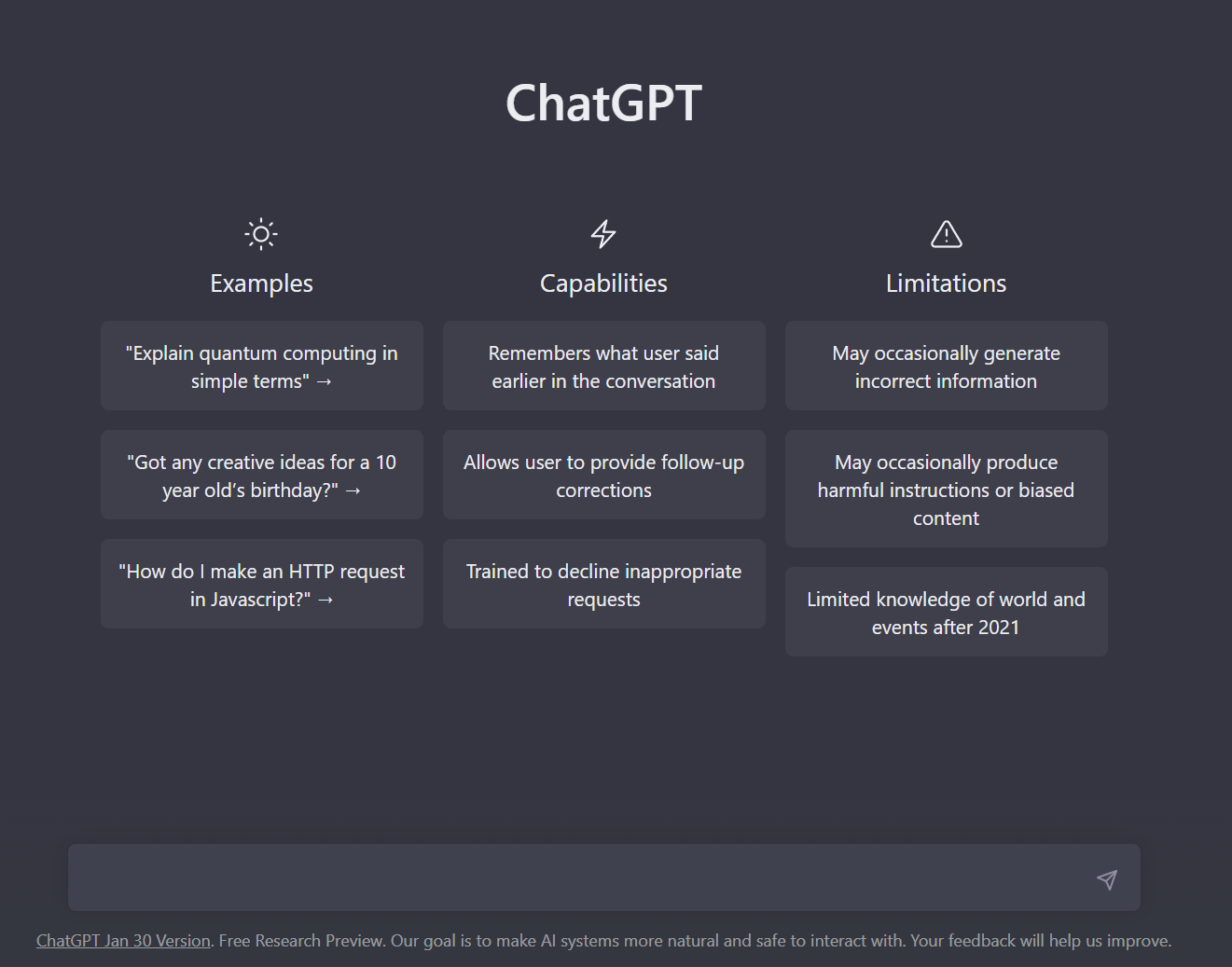
ChatGPT is a chatbot developed by OpenAI.ChatGPT is an artificial intelligence-powered tool that allows you to have human-like question-and-answer sessions with a chatbot. The primary purpose of a chatbot is to engage in behaviour that is like that of a human conversation.
ChatGPT is a GPT-3-based (Generative Pre-trained Transformer) natural language processing tool that allows users to have human-like text conversations with a chatbot. ChatGPT is optimized for dialogue by using Reinforcement Learning with Human Feedback (RLHF). ChatGPT is a Large Language Models (LLMs) that is trained with massive amounts of data to accurately predict what word comes next in a sentence. The models were trained in collaboration with Microsoft on their Azure supercomputing infrastructure.
Source: Vimeo
ChatGPT is fine-tuned from a model in the GPT-3.5 series, which finished training in early 2022.

| ChatGPT (ai-tool) | |
|---|---|
| Full Name | Chat Generative Pre-trained Transformer |
| Short Name | ChatGPT |
| Description | Human-like question-and-answer sessions with a chatbot |
| Company | OpenAI |
| Logo |  |
| Web | https://openai.com/blog/chatgpt/ |
| Category | AI Text, AI Code |
| License | Preview - free to use (Plus version TBA) |
- Snippet from Wikipedia: ChatGPT
ChatGPT is a generative artificial intelligence chatbot developed by the American company OpenAI and launched in 2022. It is based on large language models (LLMs) such as GPT-4o. ChatGPT can generate human-like conversational responses and enables users to refine and steer a conversation towards a desired length, format, style, level of detail, and language. It is credited with accelerating the AI boom, which has led to ongoing rapid investment in and public attention to the field of artificial intelligence (AI). Some observers have raised concern about the potential of ChatGPT and similar programs to displace human intelligence, enable plagiarism, or fuel misinformation.
ChatGPT is built on OpenAI's proprietary series of generative pre-trained transformer (GPT) models and is fine-tuned for conversational applications using a combination of supervised learning and reinforcement learning from human feedback. Successive user prompts and replies are considered as context at each stage of the conversation. ChatGPT was released as a freely available research preview, but due to its popularity, OpenAI now operates the service on a freemium model. Users on its free tier can access GPT-4o but at a reduced limit. The ChatGPT "Plus", "Pro", "Team", and "Enterprise" subscriptions provide additional features such as DALL-E 3 image generation, more capable AI models, and an increased usage limit. Users on the Pro plan have unlimited usage, except for abuse guardrails.
By January 2023, ChatGPT had become what was then the fastest-growing consumer software application in history, gaining over 102 million users in two months. ChatGPT's release spurred the release of competing products, including Gemini, Claude, Llama, Ernie, and Grok. Microsoft launched Copilot, initially based on OpenAI's GPT-4. In May 2024, a partnership between Apple Inc. and OpenAI was announced, in which ChatGPT was integrated into the Apple Intelligence feature of Apple operating systems. As of April 2025, ChatGPT's website is among the 10 most-visited websites globally.
External links:
- What is ChatGPT and why does it matter? — zdnet.com
- Explained: What is ChatGPT? — weforum.org
- 11 ways you can use ChatGPT to write code | Santiago — typefully.com (@svpino)
- Explaining code
- Improve existing code
- Rewriting code using the correct style
- Rewriting code using idiomatic constructs
- Simplifying code
- Writing test cases
- Exploring alternatives
- Translating code
- Writing documentation
- Tracking down bugs
- Scaffolding
- The best ChatGPT examples from around the web — learngpt.com
- https://openai.com/index/introducing-canvas —openai.com
## ToDo ##
 - Support Us... →
- Natural Language Processing
- Artificial Intelligence
- Conversational Agents
- Machine Learning
- Deep Learning
- Text Generation
- Text Classification
- Question Answering
- Dialogue Management
- Sentiment Analysis
- Language Models
- Chatbot Development
- NLP Libraries
- OpenAI
- GPT-3